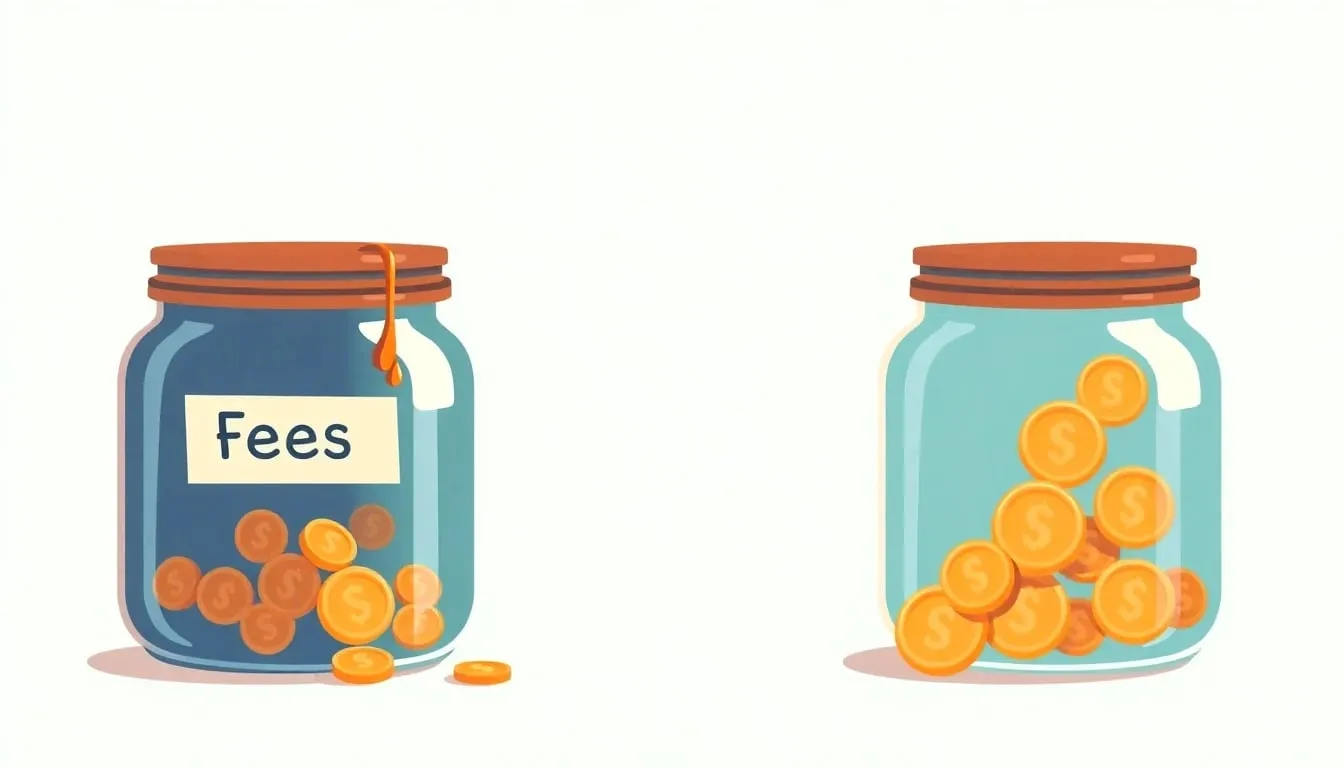
Reduce fees on index funds
“All-in-one” index funds (AIO) have become extremely popular recently as they make it dead simple to have a globally diversified portfolio that matches your needs for an affordable price. But for those interested in working a little bit you can save thousands or even tens of thousands of dollars in fees. If you’re new to AIOs, start with What are all-in-one index funds, and Mutual Funds vs Index Funds if you’re comparing against what your bank sold you.
What is an AIO Index Fund
AIO indexs are usually combinations of many smaller index funds to provide diversification but usually they come at a premium. The index fund owner charges a fee called the “Management Expense Ratio” (MER) usually between 0.1%-0.5%. For example Vanguard has the “Vanguard All Equity” fund with an MER of 0.25%, lets look at the funds components:
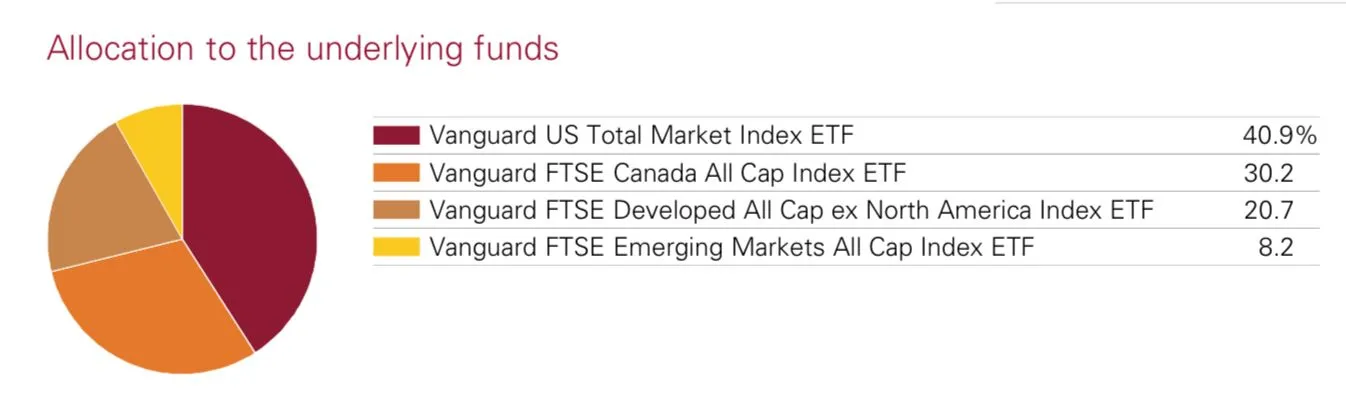
VEQT Factsheet, March 2021. VEQT is just 4 Vanguard funds combined, we could just buy those and get the same return right? Lets look at their MER:
Vanguard US Total Market Index ETF (VUN) - **MER: 0.16%**Vanguard Canada All Cap Index ETF (VCN) - **MER: 0.06%**Vanguard Developer All Cap ex NA Index ETF (VIU) - **MER: 0.22%**Vanguard Emerging Markets All Cap Index ETF (VEE) - MER: 0.24%
All of the underlying funds within VEQT have a lower MER then VEQT itself and if we weight the MERs based on the fund allocation we see the “effective” MER:
0.16% x 0.41 + 0.06% x 0.30 + 0.22% x 0.21 + 0.24% x 0.8 = 0.149%
Benefits of Purchasing Underlying Funds:
1. Reduced MER Drag
So if you buy the underlying index funds rather then VEQT you will save over 10 basis points or 0.1%. If you save $10,000 a year for 40 years that compounds to nearly $60,000 extra. Or use the Portfolio Fee Audit to compare your actual holdings against a low-cost all-in-one like XEQT.
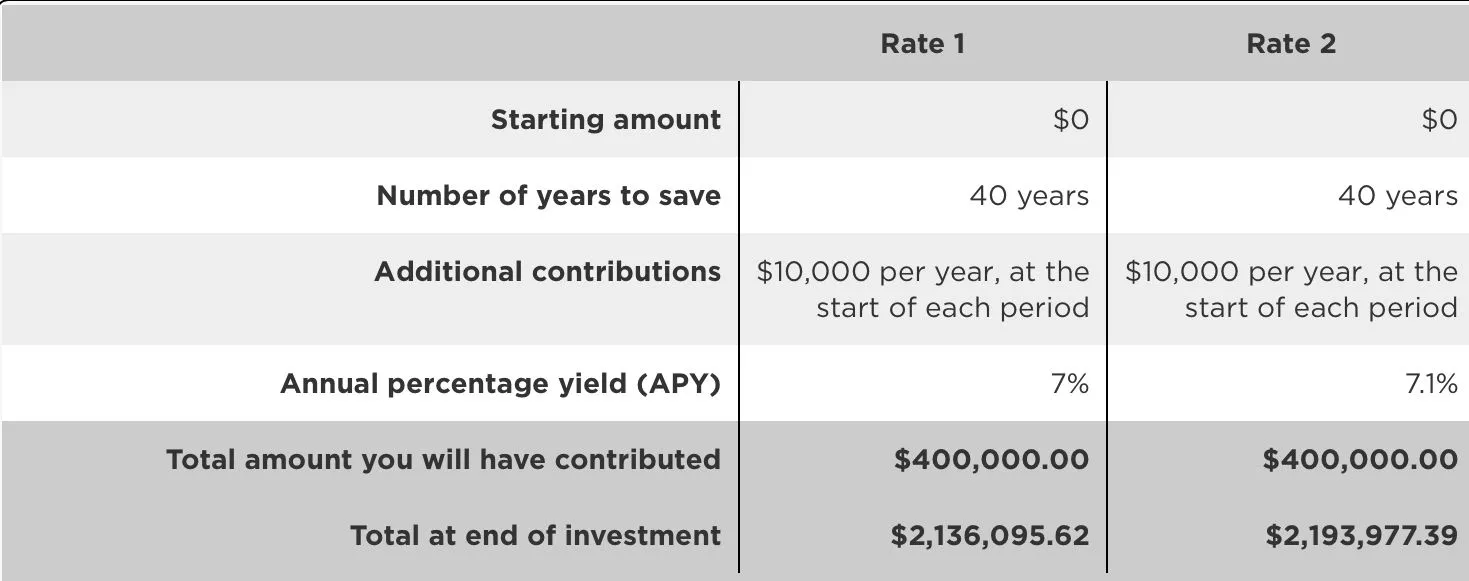
Calculated using this calculator. That averages to $1,500 a year or $125/month for simply buying 4 index funds instead of 1. Its important to note that the MERs of the underlying funds and their proportions may change increasing/decreasing the drag relative to the AIO option.
2. Tax loss harvesting
As you begin getting into unregistered investing you may find yourself exploring “Tax loss harvesting” (TLH), this is when you sell an asset at a loss and buy back a similar but different asset. The process allows you to realize capital losses and lower your income tax while still remaining invested in the market.
For example if you held $100,000 in VEQT and your portfolio dropped 30% you could sell all your holdings and buy XEQT which provides you a globally diversified portfolio but you can claim a loss of $30,000 at tax time. (VEQT and XEQT are also swap partners, see VEQT vs XEQT: Pick One and Move On for the full breakdown, or the VEQT vs XEQT comparison tool.)
It’s not ideal to sell your entire portfolio whenever you want to perform tax loss harvesting so by holding the underlying funds you can perform TLH on portions of your holdings.
3. Tax efficient account location
The RRSP, TFSA, and unregistered account are taxed differently. For example the RRSP is exempt from US witholding tax on dividends so there is an argument that you should prioritize holding US dividend paying assets within your RRSP and Canadian dividend paying assets in your TFSA or unregistered accounts.
If you hold VEQT you must have identical allocation across all your accounts but if you instead purchase the underlying funds you could prioritize VUN in your RRSP and VCN in your TFSA.
Asset location is highly debated but worth researching so you can make up your own mind. This PWL article is a great place to start.
How to purchase underlying funds easily
I use Passiv, but a manual alternative is making a spreadsheet. This builds on the Passiv setup from Self-directed investing in 5 steps. If you opt for the automated solution Passiv is a simple interface that connects with brokerages like Questrade and IBKR that allows you to create “portfolios” and in a single button click you can rebalance your account to align with your defined allocation.
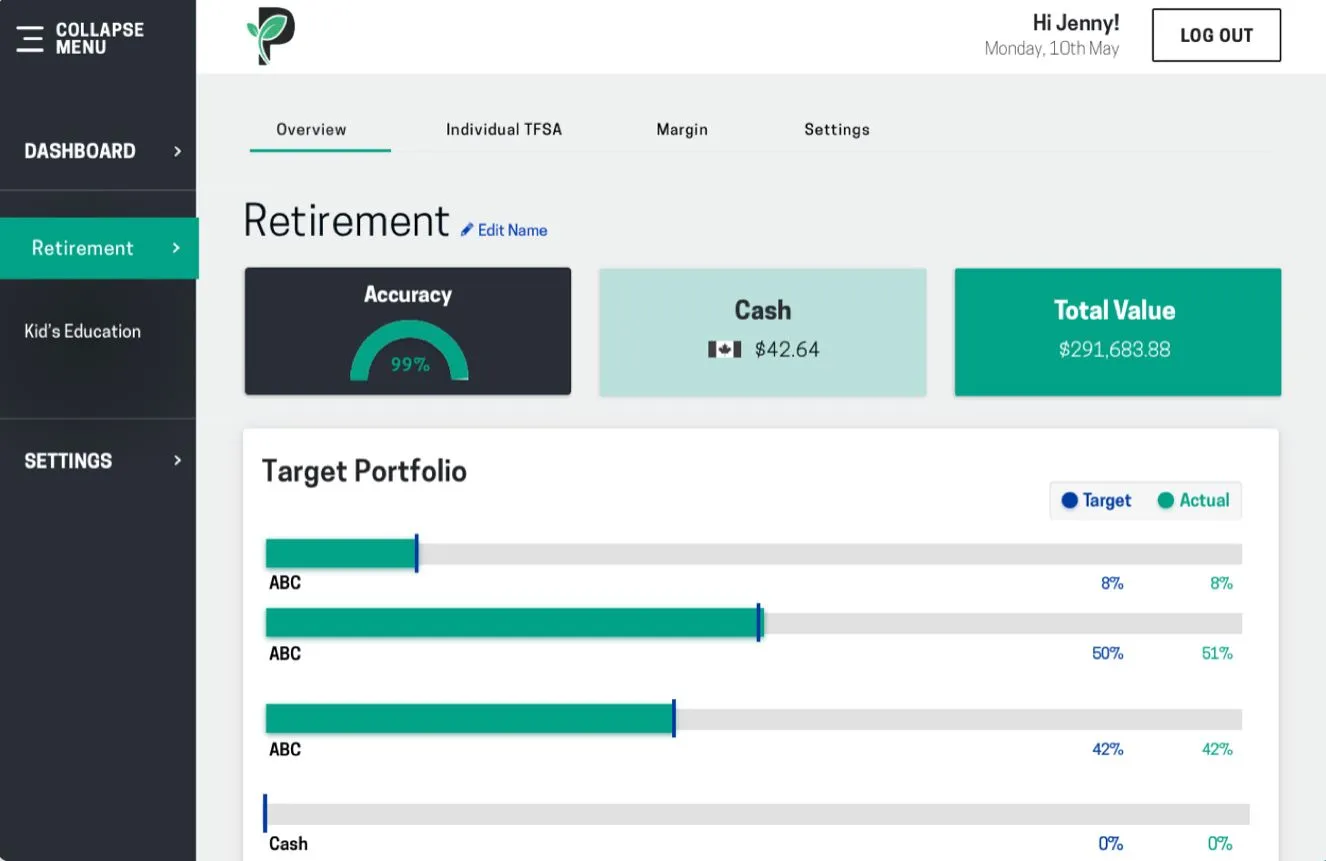
Dashboard from Passiv.com
Is it worth it?
Honestly, for most people, no. If you have less than $100,000 invested, the savings from buying underlying funds instead of VEQT amount to less than $100/year. You’ll spend more time rebalancing than you save in fees.
The all-in-one exists to remove friction. One purchase, one ticker, zero decisions. That simplicity has real value, especially when the alternative is procrastinating because you’re paralyzed by a spreadsheet. If you haven’t started investing yet, buy the AIO. If you’ve been buying VEQT for years and want to optimize, this is a nice-to-know.
For me, I buy the underlying funds partly for the fee savings but mostly because I follow a factor-tilted approach that doesn’t map cleanly to any single AIO. If that sentence doesn’t mean anything to you, VEQT is the right call.